

Change Management
Navigate change with confidence
Change management is about guiding organisations safely through change to achieve desired goals and results. Effective change management requires both a well-considered plan and an understanding of the relational and cultural dynamics unique to every workplace. Success relies on close dialogue between leaders and employees. By staying attentive to human and psychological needs, you secure buy-in, handle resistance more effectively, and promote understanding and engagement throughout the process.
Change requires planning and skilled facilitation
Changes in the workplace can put a lot of pressure on both leaders and employees. If your organisation fails to support the people driving and navigating the changes, there is a risk that your objectives will not be achieved or truly embedded in the organisation. In fact, many change processes ultimately fail because cultural and human factors are overlooked.
A successful change process therefore requires, on the one hand, a well-thought-out plan that takes cultural and relational factors in the workplace into account – combined with competent facilitation of the process. We support your business with both, ensuring a successful implementation of your desired changes.
How to secure understanding and commitment during change processes
Design the change process in close dialogue, so that improvements are aligned with your core tasks
Incorporate insight into employees’ psychological needs, and prepare your organisation for reactions and resistance
Facilitate processes that foster shared understanding and buy-in among employees
Handle conflicts and misunderstandings constructively to avoid barriers to change
Divide the process into clear steps and allow time and space to address the emotions that change can bring

How do you create effective change management?
Your company’s leadership plays an important role during times of change, and there is clear value in partnering with us for professional coaching and consultancy throughout the process. Change affects every type of an organisation – large or small – and a poorly managed process can have far-reaching consequences. At Human House, we combine the latest research in neuroleadership with extensive experience facilitating change in both private and public organisations nationwide.
Achieve the most streamlined process by involving us in both the design and facilitation stages. If your organisation prefers to facilitate the process internally, we provide a design that makes it as smooth as possible. If the process has already gone off track, we can help get it back on course and ensure that change is fully embedded across your organisation.
The different stages of a change process
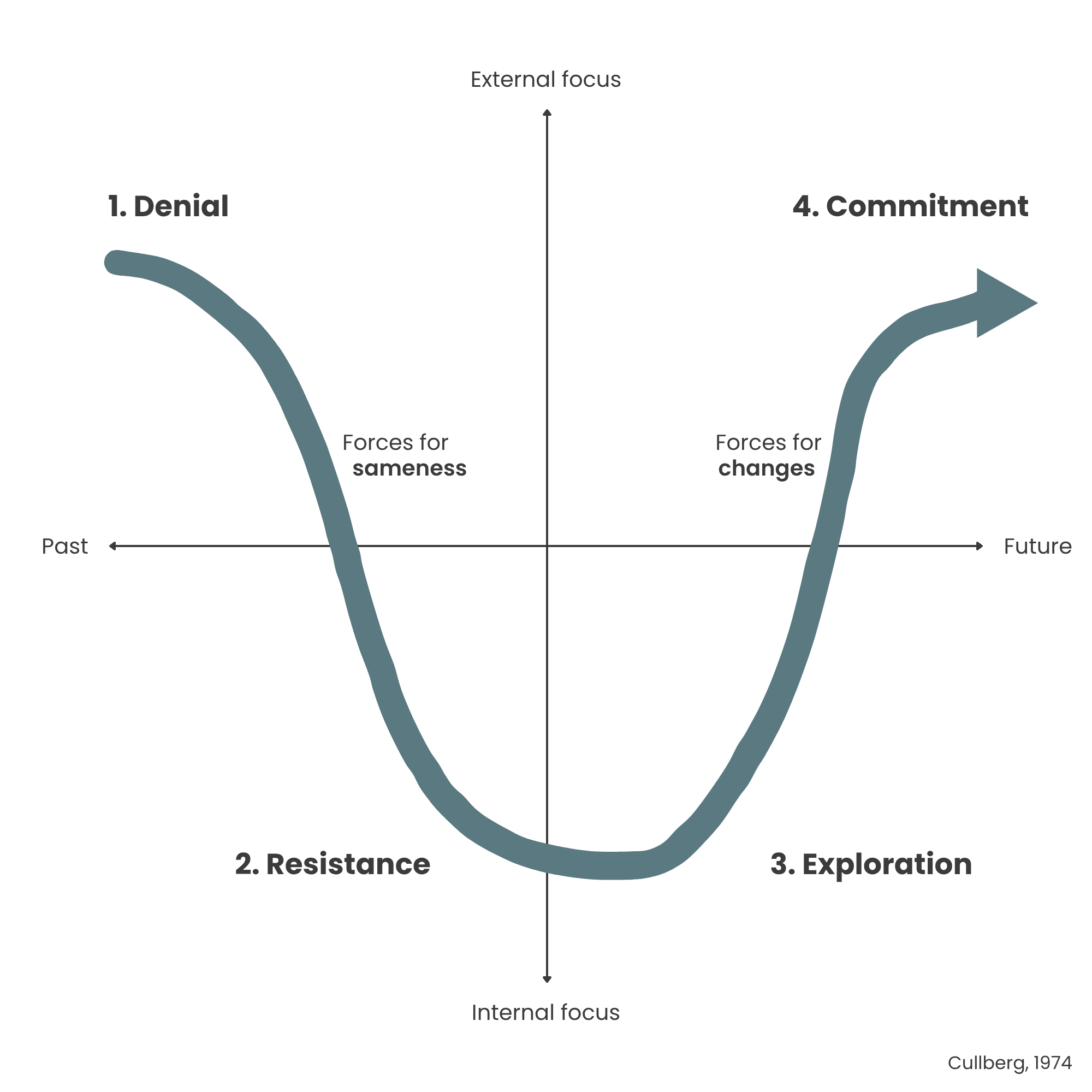
When you and your colleagues are facing change, it is useful to be aware of the stages that a change process typically involves:

Denial
The initial reaction is often denial, where employees cling to routines, turn a blind eye to change and focus on the past. This can lead to a decline in productivity and job satisfaction, as people fail to adapt to the new situation.

Resistance
Once denial wears off, resistance sets in. Employees often react with uncertainty, anxiety, nervousness, and doubts about their own abilities. Resistance can lead to conflict, illness, and inaction if employees struggle to see the opportunities in the change and fear the future.

Exploration
Gradually, employees begin to accept the change and explore new opportunities. This is where curiosity, experimentation, and questions enter the process. There is room for energy and commitment, but chaos and stress can also arise because the new framework is not yet fully clear.

Commitment
Finally, employees achieve commitment and dedication. They have gained clarity and aligned expectations and goals, and employees have accepted their new roles and are working purposefully towards delivering the desired changes.
How to deal with resistance to change?
Resistance comes in many forms – ranging from open conflict and criticism to denial, passivity, or sarcastic remarks. Some employees try to flee the issue by changing the subject or engaging in distracting activities. Others freeze, displaying denial, silence, and action paralysis, whilst some fight back by seeking conflict, displaying aggression, or seeking control. Whatever you face as a leader, you can get guidance and training to help you manage the changes.
Acknowledge resistance
Start by acknowledging resistance as a natural reaction rather than treating it as a taboo.
Create psychological safety
Encourage dialogue where employees can share their concerns by creating psychological safety and room for emotional expression.
Explore possibilities
Initiate exploratory activities where employees can experiment with the new conditions.
Make the goals clear
Ensure you facilitate collective reflection and clarify objectives and expectations, allowing the process to move from resistance to engagement.